How Much Does a Commercial Roof Cost in 2026? (And How to Avoid Overpaying)
How Much Does a Commercial Roof Cost in 2026?
Commercial roof cost in 2026 typically ranges from about $7 to $15 per square foot for full replacement, but many building owners can lower their commercial roof cost substantially by restoring or repairing an existing roof instead of tearing it off. The right decision depends on roof condition, insulation moisture, structural integrity, energy performance, and whether the current roof system is still a viable candidate for restoration.
That is where many owners get pushed in the wrong direction. They ask a simple question about commercial roof cost and get one expensive answer: replace it. In reality, the smarter question is not just how much a new roof costs. The smarter question is whether a full replacement is truly necessary in the first place. A roof that looks old, leaks in a few places, or runs hot during summer may still have strong structural life left in it. When that is the case, repair or restoration can dramatically reduce commercial roof cost while still protecting the building.
For facility managers, business owners, property managers, and building investors, this matters. Roofing is not just a maintenance line item. It affects operating expenses, tenant satisfaction, building protection, HVAC performance, and long-term asset value. That is why evaluating commercial roof cost through the lens of total ownership cost—not just installation price—is the best way to avoid overpaying.
What Impacts Commercial Roof Cost the Most?
Several major variables influence commercial roof cost, and two buildings with the same square footage can end up with very different estimates depending on layout, material type, damage level, and labor conditions. That is why price-per-square-foot averages are useful as a starting point, but not enough to make a decision on their own.
- Roof size and layout: Larger roofs can sometimes reduce the average per-square-foot price, but complicated layouts with many penetrations, drains, skylights, parapets, and rooftop units usually increase labor.
- Roofing system: TPO, EPDM, modified bitumen, metal, spray foam, and roof coating systems all carry different material costs, installation requirements, and lifespans.
- Existing roof condition: A roof with surface wear is very different from a roof with widespread insulation saturation or deck damage.
- Tear-off and disposal: Full replacement usually includes removing old materials, hauling debris away, and preparing the substrate, which adds major cost.
- Access and safety requirements: Building height, staging challenges, safety lines, crane work, and restricted access all affect labor pricing.
- Energy efficiency goals: White reflective roofing systems and restoration coatings can improve rooftop performance and lower long-term cooling costs.
According to the U.S. Department of Energy, cool roofs can reduce roof surface temperature and lower building cooling demand. That means commercial roof cost should never be looked at as a one-time number. The roof you choose can either help or hurt your operating costs for years to come.
Commercial Roof Cost: Replacement vs. Restoration
The single biggest factor in controlling commercial roof cost is understanding whether the roof needs to be replaced at all. Many building owners are presented with replacement as the default solution, but that is often because replacement is easy to explain, easy to sell, and easy to scope. It is not always the most financially responsible answer.
- Full replacement: Commonly falls in the $7 to $15 per square foot range, and can rise higher depending on roof type, labor market, tear-off conditions, code upgrades, and deck repairs.
- Restoration: Often falls in the $2 to $5 per square foot range when the roof is still structurally sound and moisture conditions allow it.
- Repair: Targeted repairs can be even less expensive, but they need to be part of a real strategy instead of endless patching without diagnosis.
That spread matters. On a 25,000-square-foot roof, even a modest difference per square foot can turn into tens of thousands of dollars. In many cases, restoration gives owners what they actually need: renewed waterproofing, sealed penetrations, reinforced seams, improved reflectivity, and additional service life without the cost and disruption of full tear-off.
That does not mean replacement is never necessary. It means replacement should be earned by evidence, not assumed by default.
Why Commercial Roof Cost Estimates Are Often Higher Than Necessary
Symptom: leaks, visible wear, ponding water, higher energy bills, interior stains, or recurring maintenance calls.
Problem: many people assume those symptoms automatically mean full roof failure.
Solution: inspect the roof carefully and evaluate repair and restoration before agreeing to replacement.
Most commercial roofs do not fail all at once. Problems usually begin at seams, flashings, penetrations, terminations, or previously repaired areas. Coatings wear down. Membranes shrink or split. Water finds a weak point. None of that automatically means the entire system is beyond saving.
This is where commercial roof cost gets inflated. A building owner sees water intrusion and hears the words “new roof.” But a responsible process asks different questions first. Is the deck intact? Is the insulation saturated everywhere, or only in isolated areas? Is the membrane failing structurally, or only at detail points? Can the system be restored and reinforced? Until those questions are answered, the largest price is not necessarily the correct price.
That is why diagnosis matters. Prognosis without diagnosis is expensive in roofing just like it is anywhere else.
How Energy Efficiency Changes Commercial Roof Cost
Energy efficiency is one of the most overlooked parts of commercial roof cost. A roof is not only a moisture barrier. It is a major part of the building envelope, which means it directly affects rooftop temperatures, HVAC demand, and overall operating efficiency.
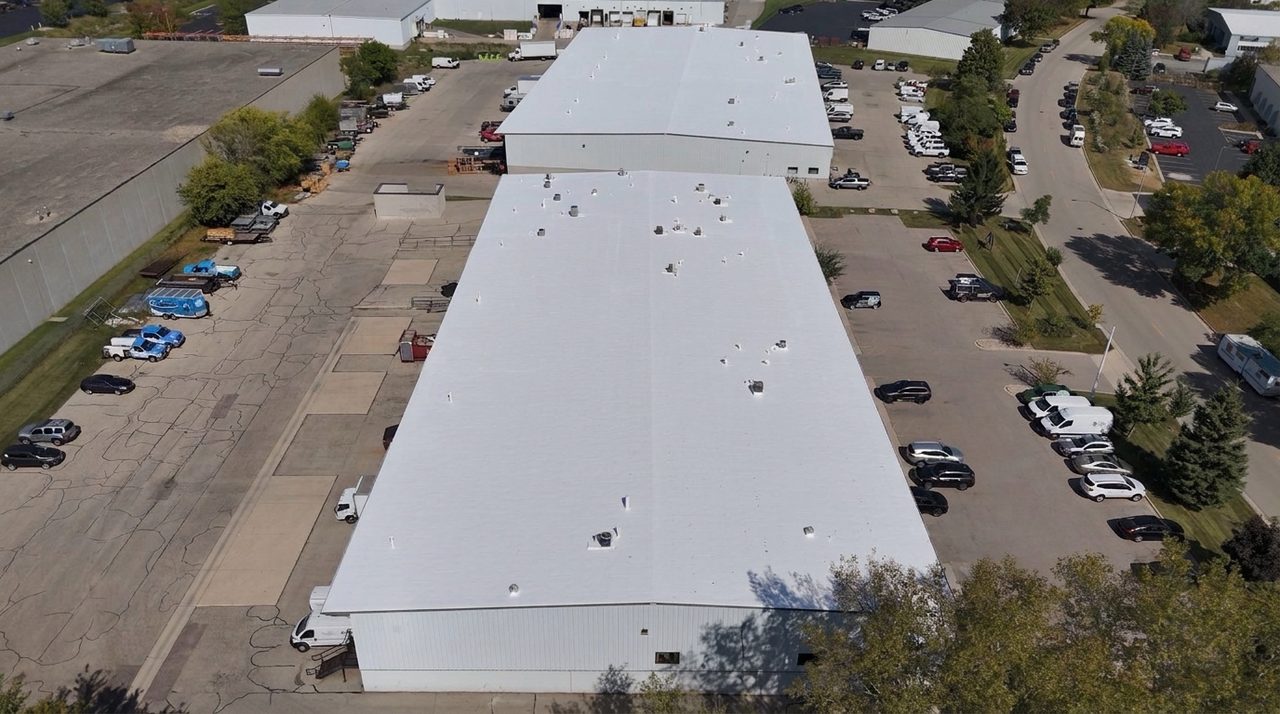
White reflective roofing systems can reflect a large percentage of solar radiation rather than absorbing it. That reduces heat buildup on the roof surface and helps lower cooling demand during warm weather. The U.S. Environmental Protection Agency explains that cool roofs can reduce building temperatures and help mitigate heat island effects. For owners, that means the roofing decision can continue affecting operating cost long after the project is complete.
When evaluating commercial roof cost, owners should ask:
- Will this solution lower rooftop temperatures?
- Will it reduce HVAC workload during peak heat?
- Will it improve indoor comfort for occupants or tenants?
- Will it help extend the service life of rooftop mechanical equipment?
- Will it reduce maintenance and utility strain over time?
A lower upfront number is not always cheaper in the long run. A roof system that performs poorly thermally may cost the building more over its service life than a higher-performing reflective system that lowers energy demand year after year.
How Long Does a Commercial Roof Last?
Roof lifespan plays a direct role in commercial roof cost because every year of safe additional service life lowers annualized cost. Different systems have different expected lifespans, and maintenance quality affects all of them.
- TPO: Often 15 to 25 years depending on thickness, installation quality, climate, and maintenance.
- EPDM: Often 20 to 30 years with proper maintenance and good seam performance.
- Metal roofing: Often 30 to 50 years depending on coating condition, fastener integrity, and environmental exposure.
- Restoration coating systems: Often 10 to 20 years per application depending on the substrate, coating type, and maintenance.
The important point is not just lifespan on paper. It is how much viable life remains in the current system. A roof near the end of its original design life may still be a strong restoration candidate if the structure is sound and moisture conditions are manageable. That can delay full replacement, extend service life, and lower total commercial roof cost dramatically.
How Weather and Climate Affect Commercial Roof Cost
Climate has a direct effect on commercial roof cost because roofs age based on exposure, not just age in years. Buildings in hot climates deal with prolonged UV exposure and intense rooftop temperatures. Buildings in colder climates may face freeze-thaw cycles that cause expansion and contraction. Storm-prone areas face wind uplift, heavy rain, hail, and debris impact.
These conditions all affect how quickly a roof degrades and which systems perform best. That is why there is no one-size-fits-all answer to commercial roof cost. The best roofing decision for a warehouse in a hot sunbelt market may be different from the best decision for a building in a region with snow load, freeze-thaw stress, or frequent severe weather.
Reflective and protective systems can reduce thermal stress. Proper drainage design can reduce ponding water. Seam reinforcement and coating protection can extend service life. The point is that the roof choice must match the environment if the owner wants real long-term value.
How Maintenance Protects Commercial Roof Cost
Routine maintenance is one of the most effective ways to control commercial roof cost. Small issues rarely stay small. An open seam, clogged drain, separated flashing, or neglected penetration can quietly turn into insulation damage, leak migration, interior disruption, and expensive emergency repair.
Preventive maintenance usually includes:
- Annual or semiannual inspections
- Drain and debris clearing
- Seam and flashing evaluation
- Targeted sealing or reinforcement
- Monitoring ponding water areas
- Checking rooftop unit penetrations and service traffic damage
Good maintenance does two things. First, it helps the roof reach its full service life. Second, it gives owners better decision data. A roof with a documented history is much easier to evaluate honestly than a roof that has been ignored until a major leak appears. In practical terms, maintenance keeps commercial roof cost lower because it reduces surprises.
When Full Commercial Roof Cost Is Justified
There are times when replacement is the right call. The goal is not to force restoration onto every building. The goal is to match the scope to the condition of the roof.
- Severe structural damage: If the deck or supporting structure is compromised, a surface solution will not solve the real problem.
- Widespread saturated insulation: If moisture is trapped across large sections of the roof assembly, replacement may be necessary.
- System-wide failure: If the roof has multiple recurring failures across the field and details, repairs may become wasteful.
- End-of-life conditions beyond recovery: Some roofs truly have no meaningful service life left.
Even in those situations, commercial roof cost should follow inspection, testing, and documentation. It should not be driven by assumption, fear, or sales pressure.
Commercial Roof Cost and Business Disruption
Another hidden part of commercial roof cost is operational disruption. Full replacement often means tear-off debris, staging, noise, odors, crew traffic, restricted access, longer timelines, and increased interference with day-to-day operations. Depending on the building type, that disruption can carry real business cost that does not appear on the roofing estimate.
Warehouses, schools, healthcare properties, retail centers, office facilities, and occupied commercial buildings often benefit from solutions that minimize disruption. Restoration systems frequently allow operations to continue with less noise, less debris, and less interruption than full tear-off projects. That matters because lost efficiency, tenant complaints, and workflow disruption are all real costs even if they do not appear on the proposal line items.
How to Reduce Commercial Roof Cost Without Cutting Corners
If the goal is to reduce commercial roof cost without sacrificing protection, the smartest path is a disciplined evaluation process.
- Start with a professional inspection: Do not approve a major scope without understanding the actual roof condition.
- Ask whether restoration is viable: A responsible contractor should evaluate repair, restoration, and replacement where appropriate.
- Compare life-cycle value: Upfront price matters, but so do service life, energy savings, maintenance needs, and disruption.
- Fix issues early: Deferred maintenance often turns a modest problem into a major capital project.
- Think in total cost of ownership: The right solution protects the roof, the building, and the budget over time.
The best commercial roof cost decision is rarely the cheapest bid and rarely the biggest scope. It is the scope that solves the actual problem while preserving the most long-term value.
Commercial Roof Cost and Long-Term Building Value
The true commercial roof cost is not just what you spend today. It is what the roof costs you over time through energy use, maintenance frequency, tenant comfort, interior risk, equipment strain, and capital timing. A roof decision affects much more than the roof surface itself.
A smart decision protects inventory, equipment, tenant relationships, employee comfort, and operational stability. It helps the building perform better. It reduces surprise leaks. It controls energy loss. It delays unnecessary capital expense. That is why building owners should think in terms of value instead of simply comparing one estimate to another.
The Bottom Line on Commercial Roof Cost
Most commercial roofs do not need to be replaced simply because they are aging, leaking in isolated places, or showing visible wear. They need proper evaluation.
Commercial roof cost in 2026 can vary widely, but the biggest financial mistake is paying for full replacement before proving it is necessary. Start with inspection, understand whether repair or restoration is viable, evaluate energy performance, consider business disruption, and compare total long-term value instead of reacting to a single estimate.
Get a Professional Commercial Roof Evaluation
If you have questions about your roof, leaks, energy loss, aging materials, or whether your current system can be repaired instead of replaced, the best next step is a professional evaluation.
White Roofing Systems connects building owners with experienced commercial roofing contractors who can inspect the roof, explain the condition clearly, and help determine whether repair, restoration, or replacement is the right path.
Do not replace your roof until you know all your options.
Keep Reading on This Site
Industry Sources
- National Roofing Contractors Association(opens in a new tab)
Commercial roofing standards and guidance.
- Cool Roof Rating Council — Building Owner Resources(opens in a new tab)
How reflective roof surfaces lower cooling load.
- U.S. EPA — Using Cool Roofs to Reduce Heat Islands(opens in a new tab)
Measured surface-temperature and energy impacts.
Frequently Asked Questions
What Impacts Commercial Roof Cost the Most?
Several major variables influence commercial roof cost, and two buildings with the same square footage can end up with very different estimates depending on layout, material type, damage level, and labor conditions.
What's the difference between commercial roof cost: replacement vs. restoration?
The single biggest factor in controlling commercial roof cost is understanding whether the roof needs to be replaced at all. Many building owners are presented with replacement as the default solution, but that is often because replacement is easy to explain, easy to sell, and easy to scope.
Why Commercial Roof Cost Estimates Are Often Higher Than Necessary?
Symptom: leaks, visible wear, ponding water, higher energy bills, interior stains, or recurring maintenance calls. Problem: many people assume those symptoms automatically mean full roof failure. Solution: inspect the roof carefully and evaluate repair and restoration before agreeing to replacement.
How Energy Efficiency Changes Commercial Roof Cost?
Energy efficiency is one of the most overlooked parts of commercial roof cost. A roof is not only a moisture barrier. It is a major part of the building envelope, which means it directly affects rooftop temperatures, HVAC demand, and overall operating efficiency.

