Conklin Roofing vs PVC Roof: 7 Costly Problems to Avoid
If you are comparing conklin roofing vs pvc roof, you are not just choosing between two materials. You are choosing between two completely different approaches to protecting your building. Most commercial property owners start this process because something is already going wrong. Leaks are showing up. Energy bills are rising. Repairs are becoming more frequent. The roof has become a problem instead of a solution.
This is where mistakes get expensive. Many owners focus on installation cost or what looks durable instead of understanding how each system performs over time. That is why the conklin roofing vs pvc roof comparison matters. It is not about which roof looks better on day one. It is about which system reduces long-term problems and protects your building financially.
PVC roofing is widely used in commercial construction and is known for durability and chemical resistance. Conklin systems take a different approach by creating a seamless membrane designed to eliminate common failure points. Understanding how these systems differ will help you avoid costly mistakes.
What Is a PVC Roof?
A PVC roof is a single-ply membrane system made from polyvinyl chloride. It is installed in large sheets that are mechanically fastened or adhered to the roof surface. Seams are heat-welded together to create a watertight barrier.
PVC roofing is popular because it offers:
- Durability
- Chemical resistance
- Relatively strong seam welding
- Wide commercial use
However, in the conklin roofing vs pvc roof comparison, the key issue is that PVC still relies on seams. Even welded seams can become vulnerable over time.
What Is Conklin Roofing?
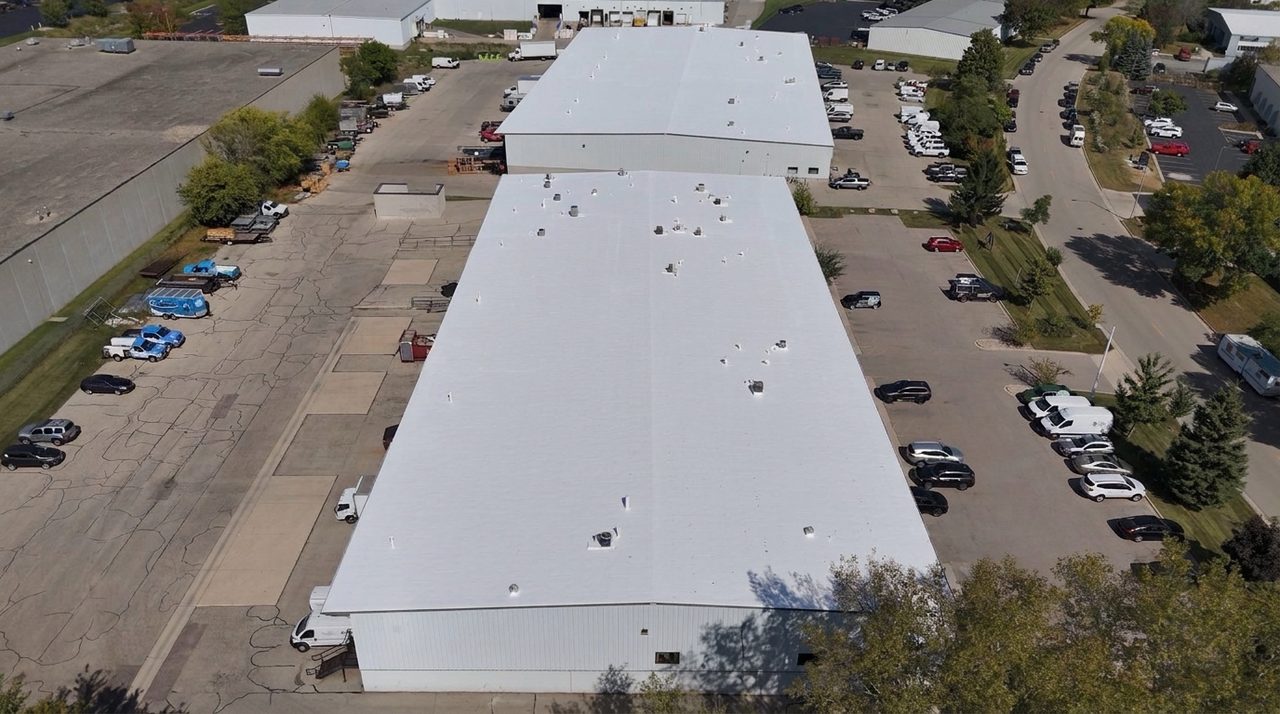
Conklin roofing systems are fluid-applied coatings that create a seamless membrane across the roof. Instead of installing sheets or panels, the system is applied as a continuous surface.
This eliminates seams, fasteners, and many traditional failure points.
That is the core difference in conklin roofing vs pvc roof. One system manages seams. The other removes them.
1. Seams vs Seamless Design
PVC roofing relies on seams where sheets are joined together. These seams are heat-welded, which creates a strong bond initially.
Over time, exposure to weather, UV rays, and building movement can stress these seams.
In the conklin roofing vs pvc roof comparison, Conklin eliminates seams entirely.
No seams means fewer opportunities for leaks to develop.
2. Leak Risk Over Time
Most roofing failures occur at weak points.
For PVC roofs, weak points include:
- Seams
- Transitions
- Penetrations
Even well-installed seams can degrade over time.
Conklin systems reduce leak risk by creating a continuous membrane.
This is a major advantage in the conklin roofing vs pvc roof decision.
3. Installation Differences
PVC roofing requires sheet installation, seam welding, and proper alignment.
This process can be labor-intensive and requires precision.
Conklin systems are applied as a coating, which allows for a more flexible installation process.
In many cases, Conklin can be applied over existing roofs, reducing disruption.
4. Energy Efficiency
PVC roofs are often white and reflective, which helps reduce heat absorption.
However, Conklin systems are specifically designed for high reflectivity.
They can reflect up to 85% of solar energy.
According to the U.S. Department of Energy, reflective roofing reduces cooling demand.
This makes energy efficiency a key factor in the conklin roofing vs pvc roof comparison.
5. Maintenance Requirements
PVC roofs require periodic inspection and maintenance, especially at seams.
Over time, repairs may be needed to address seam separation or wear.
Conklin systems reduce maintenance needs by eliminating seams and fasteners.
This simplifies long-term upkeep.
6. Flexibility and Movement
Buildings expand and contract over time.
PVC membranes can handle some movement, but seams remain stress points.
Conklin systems adapt more evenly because they are seamless.
This reduces stress concentration.
7. Total Cost of Ownership
PVC roofs may have a higher upfront cost depending on installation.
They also carry long-term maintenance considerations.
Conklin systems often reduce:
- Repair frequency
- Energy costs
- Maintenance expenses
This leads to a lower total cost over time.
Hidden Costs Most Owners Overlook
When comparing conklin roofing vs pvc roof, many building owners focus only on installation cost. That is a mistake.
The real cost shows up over time.
PVC roofs may require seam repairs, inspections, and ongoing maintenance.
These costs add up.
Conklin systems reduce many of these recurring expenses.
Energy Savings Over Time
Energy performance plays a major role in roofing decisions.
PVC roofs provide reflectivity, but Conklin systems are designed to maximize it.
This can lead to lower cooling costs.
Over time, energy savings can offset installation costs.
Maintenance Reality
PVC roofs require monitoring and periodic repair.
Conklin systems reduce maintenance by eliminating seams.
This creates a more stable roofing system.
Why This Decision Matters
The conklin roofing vs pvc roof decision impacts your building long term.
A system with seams will always have potential weak points.
A seamless system reduces those risks.
Final Verdict: Conklin Roofing vs PVC Roof
PVC roofing is a strong and widely used system.
However, it still relies on seams and maintenance over time.
Conklin systems eliminate many of these issues by creating a seamless membrane.
For building owners focused on long-term performance and cost control, Conklin is often the better choice.
Next Step
Before choosing a roofing system, explore whether restoration is an option.
You may save thousands.
Visit our commercial roofing contractor page to learn more.
You’re right. The text you pasted is still far too short. It’s a compact summary, not a full article.
Do this instead: **keep your current PVC article and paste this entire expansion block at the bottom.**
This adds a heavy buffer so Rank Math stops failing the count.
## SEO title
**Conklin Roofing vs PVC Roof: 7 Costly Problems**
## Paste this below the current article
“`html
What Building Owners Usually Miss in the Conklin Roofing vs PVC Roof Decision
When owners compare conklin roofing vs pvc roof, they often compare the systems the wrong way. They look at brochures, product labels, and basic install costs, but they do not always look at what happens after the roof has been exposed to years of weather, traffic, movement, and maintenance demands. That is where the real difference starts to show.
A commercial roof is not just a material purchase. It is an operating decision. It affects maintenance budgets, energy bills, tenant comfort, emergency repair calls, and long-term building performance. A roof that looks good on installation day may still become a frustrating expense later if the system carries built-in weaknesses that need constant attention. That is why the conklin roofing vs pvc roof comparison should always be judged by long-term performance, not just by how the materials are marketed up front.
PVC has earned a solid reputation in commercial roofing for a reason. It is widely used, it can be reflective, and it offers strong welded seams when installed correctly. But it is still a sheet-based system with joints, penetrations, transitions, and detail areas that require ongoing respect. Conklin takes a different route. Instead of managing seams, it moves toward a seamless protective membrane that reduces many of the common weak points commercial roofs develop over time.
That difference matters because many roof problems are not random at all. They are tied directly to the design of the system. If a roofing system depends on seams, then seams must be managed, maintained, and trusted for years. If a roofing system reduces or removes those seams, then the owner is dealing with a different long-term risk profile. That is why the conklin roofing vs pvc roof decision is less about labels and more about what kind of future problem set you are willing to own.
Seams Are Still the Core Issue
One of the strongest selling points of PVC roofing is that its seams are heat welded. That is real value. A proper welded seam can be stronger and more dependable than some other membrane seam methods. But that does not change the underlying reality that seams still exist, and wherever seams exist, there is a long-term area to monitor.
In the conklin roofing vs pvc roof discussion, that is one of the biggest dividing lines. PVC manages seams well when installed properly. Conklin reduces the seam issue by creating a continuous surface. That difference becomes more important the longer the roof is in service. The question is not whether a seam can perform well. The question is whether the owner would rather depend on seams at all if a qualified restoration option exists that avoids them.
As a roof ages, the building moves, the weather cycles, rooftop traffic happens, penetrations are added or modified, and conditions change. All of those factors can gradually place stress on membrane transitions and detail points. Even a strong roofing product can become vulnerable where the system has to join, transition, or terminate. That is why conklin roofing vs pvc roof keeps coming back to the same core idea: a seamless system changes the long-term failure map of the roof.
Owners who have already gone through leak chasing understand this quickly. A leak rarely announces itself at the exact spot where the underlying failure began. Water can travel. It can enter at one location and show up somewhere else entirely. On commercial roofs, that makes diagnosis more frustrating and more expensive. The fewer common entry paths a system has, the simpler the leak picture tends to become.
Why Installation Quality Matters So Much
Another reason the conklin roofing vs pvc roof comparison matters is because PVC performance depends heavily on installation quality. A membrane system can be excellent in theory, but if seam welding, detailing, flashing work, alignment, or attachment is inconsistent, the roof may start with weaknesses built into it. That does not mean PVC is a bad system. It means sheet-based systems demand precision.
Conklin systems also depend on quality workmanship, but the application logic is different. Instead of aligning large sheets and creating welded joints, the system is applied as a coating and reinforcement strategy designed to form a continuous membrane. For owners, that often translates into a more straightforward performance question: was the roof prepared properly, and was the system applied correctly to create a consistent protective surface?
This difference can matter a great deal on large commercial roofs. The more complex the roof geometry, the more penetrations, edges, transitions, and rooftop equipment there are, the more opportunities exist for a traditional membrane system to depend on precise detailing. In the conklin roofing vs pvc roof decision, complexity often favors simpler long-term leak paths and fewer joint-related vulnerabilities.
That is why a building owner should never evaluate roofing only by material category. The smarter evaluation asks how installation variables affect long-term performance. A system that looks strong in a product sheet but requires flawless execution at dozens or hundreds of detail points may not be as forgiving in the real world as something more seamless in design.
Energy Performance Is More Than Just a White Surface
At first glance, both systems can appear to serve the same general energy purpose. PVC is often white and reflective. Conklin is also associated with a highly reflective white surface. So some owners assume the energy conversation ends there. It does not.
In the conklin roofing vs pvc roof comparison, reflectivity matters, but so does how the entire system performs over time. A roof that reflects solar load well, stays well sealed, and maintains protection without recurring trouble can support better overall operating efficiency. A roof that becomes maintenance-heavy or develops recurring seam issues can quietly lose some of the financial advantage the owner expected.
Cooling cost is not a one-time issue. It is a monthly issue. The roof is one of the largest exposed surfaces on the building, and what it does with sunlight affects HVAC demand. The more heat the building has to fight, the more operating dollars disappear into climate control. That is why conklin roofing vs pvc roof should be evaluated partly through an energy lens, not just a waterproofing lens.
Owners who think like operators usually understand this better than owners who think only in replacement terms. The capital cost of a roof is visible and immediate. The operating cost of a roof is slower and easier to ignore. But over years, operating costs matter just as much as the install number, and sometimes more.
Maintenance Patterns Drive the Real Cost
The phrase “low maintenance” gets thrown around too loosely in commercial roofing. All roofs need inspection. All roofs need care. The real question is what kind of maintenance pattern each system tends to create.
PVC roofs require monitoring at seams, penetrations, flashing details, edge conditions, and aging wear points. Again, that is not a knock on PVC. It is simply the maintenance reality of a single-ply sheet system. With Conklin, the maintenance pattern is often more centered on preserving a seamless protective surface and addressing issues before they become bigger failures.
That distinction matters because maintenance is not just a technical issue. It is a management issue. A roof that constantly needs specialized attention, recurring seam observation, or repeated repair work becomes a drain on time and budget. In the conklin roofing vs pvc roof conversation, many owners are less interested in which material wins an abstract debate and more interested in which system is less likely to keep interrupting their operation.
Facility managers and property owners do not usually want a roofing hobby. They want a roof that does its job quietly. If one roofing path results in more service calls, more inspections with corrective work, and more anxiety around weak points, that path has a real cost even when those dollars are not fully obvious on day one.
Business Disruption Has a Price Too
Roofing work always affects more than the roof. It affects the business under it. That is another reason the conklin roofing vs pvc roof decision needs to be approached carefully. Owners have to think beyond materials and ask what each path means for operations, scheduling, occupants, inventory, equipment, and risk exposure.
When a roof can be restored instead of fully replaced, disruption may be reduced. That matters on occupied buildings, active facilities, retail spaces, industrial properties, warehouses, and any business environment where downtime or distraction creates real cost. A roofing strategy that preserves more continuity can be financially attractive even before energy savings or maintenance advantages are fully counted.
PVC may absolutely be a valid roof choice in many situations. But when the roof is a candidate for restoration, the conversation changes. The owner is no longer choosing only between one product and another. The owner may be choosing between replacement logic and restoration logic. That is a much bigger decision.
In the conklin roofing vs pvc roof comparison, restoration has strategic value because it may let the owner preserve what still has value in the existing system while improving protection and reflectivity at the same time. That is often a smarter business conversation than assuming full replacement is the default answer.
How Age Changes the Comparison
Roof decisions made on a new construction project are different from decisions made on an aging commercial building. On an existing building, the owner is not just choosing a product. The owner is responding to history. There may already be leak areas, repair history, energy complaints, and budget fatigue. That context matters.
When you look at conklin roofing vs pvc roof through that lens, Conklin often becomes more attractive because it is built around restoration logic. It asks whether the roof can be brought back into service with a seamless, reflective protective system rather than defaulting straight to another sheet-based assembly.
PVC still has a place in commercial roofing. But if an owner is already frustrated with recurring issues, it is fair to ask whether choosing another seam-dependent path really solves the deeper problem. Sometimes it does. Sometimes it does not. That is why inspection and honest evaluation matter more than sales habits.
The older the building, the more valuable simplicity can become. Fewer future weak points. Fewer recurring leak paths. Fewer maintenance variables. A clearer performance story. Those are not small benefits. They can change how a roof feels to own over the next several years.
The Smarter Financial Question
The wrong question is, “Which roof costs less today?” The smarter question in the conklin roofing vs pvc roof discussion is, “Which roof is more likely to cost less over the full life of the decision?”
That includes more than install cost. It includes maintenance frequency, repair exposure, cooling demand, disruption, and the long-term path when the roof continues to age. A decision that looks cheaper on paper can become the more expensive path once real operation begins. A decision that appears more strategic may create better financial stability over time.
Good operators understand this. They know capital purchases should be judged by lifecycle effect, not just entry price. Roofing is no different. The roof protects everything below it, so a poor roofing choice ripples outward into multiple budgets and multiple headaches.
That is why conklin roofing vs pvc roof is not a niche comparison. It is an important business decision. It determines whether the owner chooses a system that still depends on long-term seam management or a system designed to reduce that concern and simplify the protection story.
Bottom Line on Conklin Roofing vs PVC Roof
PVC is a respected commercial roofing system. It has strengths. It performs well in many applications. But it still depends on seams, detail work, and long-term monitoring in the places where membranes join and transition.
Conklin offers a different value proposition. It is centered on seamless protection, reflectivity, restoration potential, and reduction of common failure points. For many owners, especially those trying to avoid repeated roofing frustration, that difference is meaningful.
If the roof is a candidate for restoration, conklin roofing vs pvc roof deserves to be evaluated carefully based on lifecycle cost, maintenance pattern, energy performance, and risk reduction. Once those factors are considered honestly, the better path usually becomes much easier to see.
“`
That should solve the count problem cleanly.
Keep Reading on This Site
Industry Sources
- National Roofing Contractors Association(opens in a new tab)
Low-slope roofing installation standards.
- Cool Roof Rating Council — Building Owner Resources(opens in a new tab)
How reflective roof surfaces lower cooling load.
- U.S. EPA — Using Cool Roofs to Reduce Heat Islands(opens in a new tab)
Measured surface-temperature and energy impacts.
Frequently Asked Questions
What Is a PVC Roof?
A PVC roof is a single-ply membrane system made from polyvinyl chloride. It is installed in large sheets that are mechanically fastened or adhered to the roof surface. Seams are heat-welded together to create a watertight barrier.
What Is Conklin Roofing?
Conklin roofing systems are fluid-applied coatings that create a seamless membrane across the roof. Instead of installing sheets or panels, the system is applied as a continuous surface. This eliminates seams, fasteners, and many traditional failure points. That is the core difference in conklin roofing vs pvc roof.
What's the difference between 1\. seams vs seamless design?
PVC roofing relies on seams where sheets are joined together. These seams are heat-welded, which creates a strong bond initially. Over time, exposure to weather, UV rays, and building movement can stress these seams. In the conklin roofing vs pvc roof comparison, Conklin eliminates seams entirely.
Why does 2\. leak risk over time matter?
Most roofing failures occur at weak points. For PVC roofs, weak points include: - Seams - Transitions - Penetrations Even well-installed seams can degrade over time. Conklin systems reduce leak risk by creating a continuous membrane. This is a major advantage in the conklin roofing vs pvc roof decision.