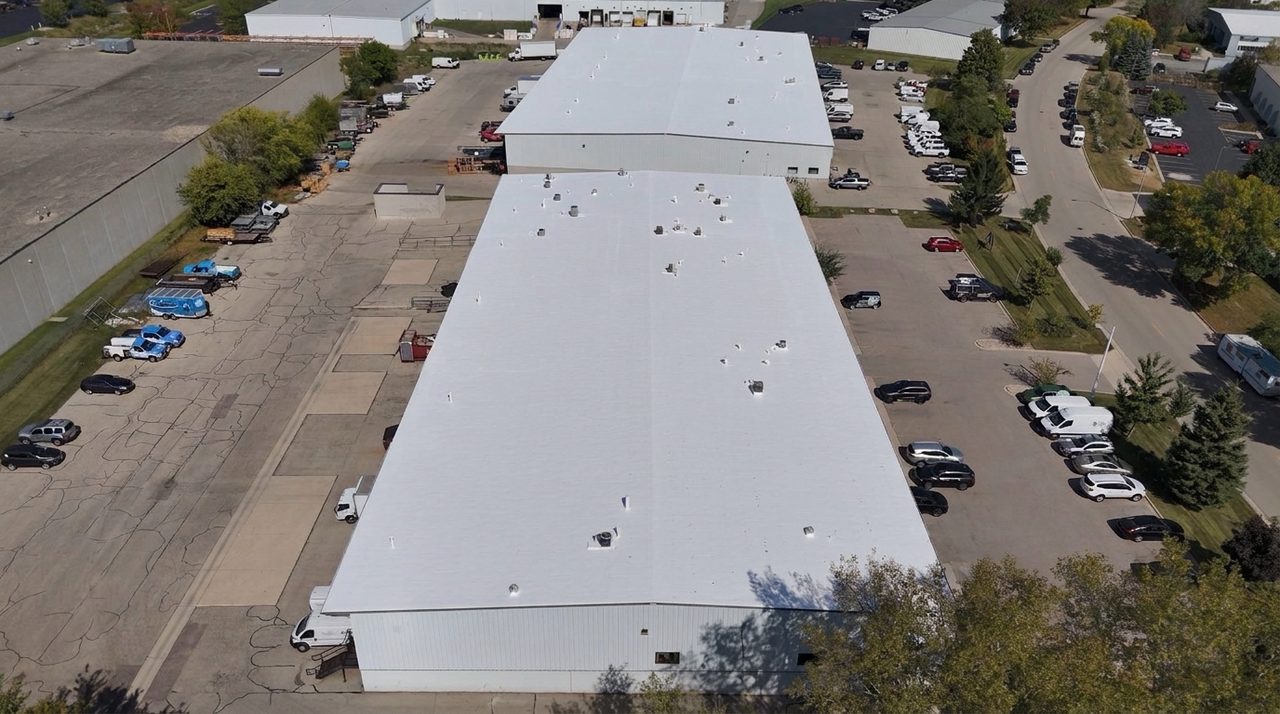
Metal Roof Leaks: Why They Start and How to Stop Them
Why is my metal roof leaking?
Almost never through the panel. Metal roofs leak at the fasteners, the seams, and the penetrations. The steel itself usually has years of life left while the parts holding it together have quietly given up.
The cause is movement. Metal expands in heat and contracts in cold, every single day, for the life of the building. That constant cycling works screws loose, elongates the holes they sit in, flattens rubber washers, and opens the laps between panels.
The symptom: stains that do not line up with the leak
Water enters at a fastener near the ridge and runs down the underside of the panel before it drips. The ceiling stain shows up twenty feet from the actual hole. Owners chase the stain, seal the wrong spot, and the leak comes back with the next hard rain.
Other early signs: rust blooming around screw heads, daylight visible at end laps, gutters full of rusty grit, and stains that only appear on wind-driven rain rather than every storm.
The problem: caulk and screws are a two-year fix
The common repair is to run a bead of sealant over the fastener heads and replace obvious bad screws. Both fail on the same schedule. Sealant hardens and cracks under UV. Oversized replacement screws go back into holes that are already elongated, and the movement that stripped them the first time has not stopped.
So you are back on the roof in two years, only now there is rust under the panel and more open seam length than before.
The solution: seal the movement, do not fight it
A Conklin metal roof restoration deals with the actual failure mode:
- The roof is washed and any rust is treated with a rust-inhibitive primer so it stops spreading under the new system.
- Failed fasteners are replaced with oversized fasteners sized for the worn holes.
- Seams, laps, ridges, and every penetration get reinforcing fabric embedded in base coat. The fabric flexes with the panel instead of cracking when it moves.
- A reflective acrylic top coat goes over the whole roof, cutting the surface temperature and reducing how much the metal cycles in the first place.
That last point is the one owners miss. Lowering the panel temperature reduces thermal movement, which is the root cause of the leaks. You are not just sealing holes, you are slowing the process that makes new ones.
When restoration is not enough
If the panels are rusted through, if the purlins or deck are compromised, or if the insulation under the panels is soaked, restoration is the wrong tool. That roof needs panels replaced. An honest contractor will tell you which one you are looking at. More on the tradeoff in repair versus replacement for a metal roof and why coating a metal roof works.
Talk to a contractor installing Conklin systems near you
No article can tell you what your roof needs. Metal leaks hide from you, so finding the entry point takes a walk on the roof. A contractor has to walk it, check the seams and penetrations, and look at the deck before anyone gives you a real answer.
White Roofing Systems coordinates commercial roofing crews installing Conklin systems across the country. Call (309) 303-3128 or request a free roof inspection and we will route you to the contractor who covers your city. You can also browse the contractor directory by city and state or look through real before-and-after projects.
Keep Reading on This Site
Industry Sources
- Metal Construction Association(opens in a new tab)
Metal roof panel and fastener standards.
- Cool Roof Rating Council. Building Owner Resources(opens in a new tab)
How reflective roof surfaces lower cooling load.
- U.S. EPA. Using Cool Roofs to Reduce Heat Islands(opens in a new tab)
Measured surface-temperature and energy impacts.
Frequently Asked Questions
How long does a metal roof restoration last?
It depends on panel condition, the system applied, and maintenance. Ask the contractor to put the expected service life and the warranty terms in writing.
Can you restore a rusted metal roof without replacing it?
Yes. Surface rust is treated with a rust-inhibiting primer, fasteners are tightened or replaced, seams are reinforced with butyl tape and fabric, then two coats of Conklin acrylic top coat seal the entire roof. No tear-off is needed as long as the panels and structure are sound.
How much does metal roof restoration cost vs. replacement?
Whether restoration costs less than replacement depends on the roof's condition, which an on-site inspection confirms. A written proposal compares both after the inspection.
Will the coating stop leaks at the seams and fasteners?
Yes. Every seam and fastener is reinforced with butyl tape, polyester fabric, and base coat before the top coats are applied. The finished system is fully monolithic and waterproof.